Wednesday, October 18, 2017

Oswego Music Hall of Fame 2016 rock band inductee The Rockin' Hi Lows


The 2016 Oswego Music Hall of Fame Inductees, Rockin’ Hi-Lows, 1958.
From left: Dave Rebeor, Ed Powers, Freddy Greco, Terry Fistick, and Dave Buske


Rock'  n' roll was the kick in the mid-1950's and all the hip cats wanted to rattle.

At the same time, Freddy Greco and Terry Fistick, both of Fulton, Dave Rebeor and Ed Powers, of Minetto, and Dave Buske, of Oswego, were five young turks still in high school, ready to blast.

In 1957, at that intersection of progressive new music and hotdogger ambition, Oswego County’s famous Rockin’ Hi-Lows was born:

Freddy Greco:  lead vocals, sax
Dave Rebeor:     lead guitar
Ed Powers:         piano, backup vocals
Terry Fistick:       drums
Dave Buske:        bass
The boys autographed the back of their promo shot.

The music
The music was boogie-woogie style like that of Chuck Berry and Chubby Checker: heavy on sax and double-string electric guitar talk-back, with energetic drumming and plenty of flourishes and fills. Piano chords were hammered out fast and furious. Song lyrics were ripe with fast cars, fast women, and heartbreak. The groove was fun, and the beat was easy to dance the jitterbug and the twist.

Venues
The band jammed entertainment venues and high-energy dance halls like Three Rivers Inn, in Seneca Knolls, The Fish Net, in Sylvan Beach, and Central High School, in Syracuse.


Getting on The Charts
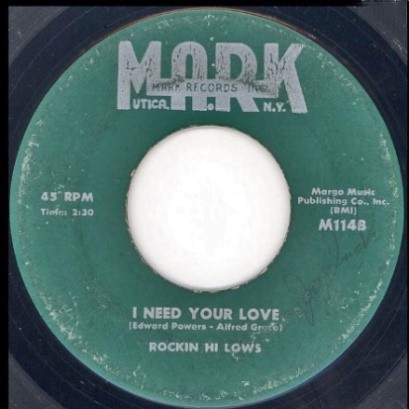
In that era, the only way to break through to the big scene was with a hit record. In a wild trip to New York in early 1958, Rockin' Hi-Lows recorded their only 45.

The A-side was a cover of The Sputniks' “Hey Mary Ann".

The B-side was the group's original tune, a local crowd pleaser, "I Need Your Love”, written by Greco and Powers.
The disc received heavy rotation on local radio. Musician's lore is that “I Need Your Love” reached 101 on the music charts – just one hair outside Billboard's Top 100 and a rocket boost to fame.


After Hi-Lows
The rock ' n ' roll scene evolved quickly, and by 1959, the freshly minted rockers had each moved to new projects.

Greco formed and fronted The Kingsmen with Powers.

At about the same time, Bill Cook reorganized his Billy and the Barons lineup. Original members Jack Henderson, on drums, and Gary Illingworth, on piano, stayed with the group. The new ticket saw Rebeor in for Buddy Murray, on lead guitar, Ray Smith in for Frank Rowe, on bass, and the addition of Kenny Germain on sax.

Fistick dropped out of the scene for a while, then resurfaced in Yello-Bric Road with Pat Hillman and Jimmy Dillabough.

Through the decades, all these men would find each other again and again as Oswego County's progressive music scene evolved, grew, and entertained us all.

Where are they now?
The everlasting jam session in the sky inducted Buske, Rebeor, and Fistick.

Greco lives in Mexico, NY, with his wife, Noreen.
Ed Powers

Now in his 70s, Powers took the stage during the 2017 Oswego Musicians Hall of Fame Induction ceremony and kicked off the rust to play one more time with The Eddie Goodness Quartet.

With a bass strapped on his shoulder, one hand moved smoothly along its neck while the other plucked and strummed it, intimate and familiar.

Steeped in decades of charm and charisma, and as if no time had passed, he sang a few songs to the delight and applause of the crowd.

by JL Rebeor
10/18/2017

Sunday, February 26, 2017

Meme Contempt

CFI Library, Amherst, NY
Right now reality feels malleable.
Attributed quotes are meaningless unless fact checked. And checked again. And the checkers authenticated. And everything sourced.
But that's not the malleable part.
As people seek to derive power from an authoritative source they redefine and mold others' words, ideas, and situations to conform to what they want to express. Realities are bent to the speaker's will and then out spews memes and what's now being called 'fake news'.
Don't even get me started on plagiarism.
In this new era of high alert skepticism, a sense of reason forced me this morning to offer a correction on a social media site for a meme which misquoted Thomas Paine. I don't usually bother trying to fix social media but the poorly paraphrased quote bothered me.
The misquote equated the futile behavior of arguing with an unreasonable person to administering medicine to the dead.
Common sense on its own, but it's not what Paine said.
While it may have conveyed the writer's thought its brevity lost much of Paine's meaning. And despite any good intention, it was just one example too many of mob mentality groupthink fakenews alt-fact as malleable reality.
Ironically that post had several hundred comments which expressed overwhelming agreement, and as of this morning shared over 5,000 times.
The camel's back, she broke.
Here is the actual quote, which I will be thinking about for much of the day:
“To argue with a man who has renounced the use and authority of reason, and whose philosophy consists in holding humanity in contempt, is like administering medicine to the dead, or endeavoring to convert an atheist by scripture.” -The American Crisis: Lancaster, March 21, 1778, Thomas Paine to William Howe
The phrase "and whose philosophy consists in holding humanity in contempt" was completely missing from the meme but it is crucial to the message.
Motive matters.
A philosophy which holds humanity in contempt is soulless.
Paine goes on to tell Howe to enjoy his "insensibility and reflecting." He equates that decision to "the prerogative of animals" and ends his opening paragraph by telling Howe, "no one will envy you these honors, in which a savage only can be your rival and a bear your master." (sick burn TP)
But don't quote me.
Read it for yourself: The American Crisis: LANCASTER, March 21, 1778, by Thomas Paine
-Reb

Sunday, January 22, 2017

Women March In Seneca Falls Impetus

When you’re going outdoors in the cold you need to dress in layers and bring a coat. Prepared for a change in the weather, I wondered what else would change today.

The Women March in Seneca Falls took to foot at 10 a.m. on Jan. 21, 2017. People gathered in the park for hours beforehand.

Women, girls, men and boys walked 10 – 20 abreast on the hamlet’s downtown streets. They began at The National Women’s Rights Historical Park, chanted, carried signs, laughed and talked along the way to the First Presbyterian Church – the site of the first convention for women’s rights in 1848, and where today's afternoon rally was slated to begin at noon.

Marchers sign’s messages were as varied as the people carrying them: “Choose Love Choose Hope Choose Kindness”; “Women’s Rights Are Human Rights”; “Hands Off My Pussy” (carried by an old woman in a wheelchair); “A Woman’s Place Is In The Revolution” (carried by a man); and a dog who’s sign read “I Would Never Grab A Pussy.”

There was “Climate Change Is Real, Bigly” and “Honk for Science.”

A man wearing a black shirt and white clerical collar held the message “Girls Just Want To Have FUNding for Planned Parenthood.”

And my personal favorite – black letters on white poster board – “Seriously There Are SO MANY REASONS Why I’m Here and this sign is only so big.”

The day started out chilly but by 11 a.m. the sun had been shining for hours. For Central New York It was an unseasonably warm winter day.

Women who went only for the march walked away from the historic downtown hub in singles and doubles to their cars parked blocks or miles away. Some still wore their coats, accessorized with white, gold or purple scarves and hats. Others carried theirs or wrapped them around their waists.

There was excited chatter on the street. Laughter. And hugs.

Traffic cops at the Cayuga, Fall and Ovid Streets intersection directed cars and pedestrians, keeping each safe from the other.

“Thank you,” a group of women shouted, smiling to the officer who waved them through, as they trotted past.

I walked around the outskirts of the six blocks or so that contained the rally to get a feel for the size of the crowd. Several blocks away I heard the amplified speech of a woman. Following the sound of her voice, I walked through the mud along the railroad tracks to find the throng outside the church.

The parking lot is a courtyard enclosed on three sides by brick buildings and the historic towering church. It was a wall-to-wall sea of women and men and children, strollers and wheelchairs and well-mannered dogs on leashes. The sound from the jumbotron speakers was bouncing off the brick and the words echoed through the neighborhood.

Syracuse Mayor Stephanie Miner spoke to those packed inside the church and the thousands who watched her on the parking lot big screen.

“We’ve lost sight of the fact that we have to work hard for our values,” Miner said. She urged women to step up and run for office, participate in the process, “use your voice.”

Women clapped and hooted in that high-pitched way which only women can. The feeling was excitement, support, love, acceptance, and understanding.

Throughout the crowd, men looked after children while women listened with eyes raised toward the sky (OK jumbotron).

Next up was New York State United Teachers President Karen Magee. She told us the importance of quality public education for all, calling it “the great equalizer.”

One of the three-dozen-plus afternoon speakers was event coordinator Maureen Quigley. She talked about the power of biblical Eve, and Gaea, the goddess of the earth. She detailed her struggle to advocate for her son Hank and the support she received. And when she mentioned Hillary Rodham Clinton’s name, the silent crowd erupted into cheers and applause.

I wondered in that moment if there were Trump supporters in the majority white-woman crowd.

For hours there were speakers entertainers and poets proclaiming from the pulpit support for, or a testament to human rights, equal rights, women’s rights, reproductive rights, and a determination to keep all of them intact.

My afternoon notes were sparse – this day I wanted to be a present observer, not a reporter. (My hope is that in the coming days there will be videos and transcripts online. It was an emotional day better written objectively with some reflection.)

A few members of the crowd and afternoon speakers lobbed kicks at the divisiveness generated by the new president during his campaign. But for the most part, everyone was respectful of the cause for the day and mindful that its cause was not its impetus.

The November election brought us the day, human rights was the force that moved us.

online image, Washington, D.C.
In the sea of people, suffrage colors of purple, gold, and white were everywhere. In Washington D.C., the women were encouraged to wear pink hats – a knitted hat sewn square so when worn the corners stuck up like pussy cat ears. It was called the Pussy Hat Project.

Many in Seneca Falls also wore pussy hats.

A woman of advanced age sported a regal purple felt fedora festooned with a sparkling gold band and bow, and in my mind won the award for best execution of a hat.

Women can express complex ideas and look damned good, too.

Local news estimated 10,000 people were in Seneca Falls for the march. Early news reports said 500,000 marchers were in Washington, D.C., and 3.5 million worldwide.

Thousands of different causes, one impetus – the voice of human beings united has power.

As the afternoon wore on and the crowds started to thin my phone began to buzz. With so many people in such a small community, the nearby cell towers had likely been overloaded for hours. Text messages came in calling me back. It was time for me to go home.

Back on the street others’ conversations drifted in the air.

“Seneca Falls is such a low-key place,” said a woman to her friend.

“We’ve got to get Trump to put a woman on the Supreme Court,” another said as I passed. “He’s pissed off every woman in the United States.”

People clumped together and murmured about the time, lunch, finding others from their group.

The mood was warm, content, and ready to move on.

“No protest is complete without a trip to the port-a-potty,” a woman said to me as she headed toward a line of Blue-Bowls.

“Did you have a good day?” one woman asked from traffic through her open truck window.

“It was a great day,” a woman answered. “I talked to so many new people.”

Grassy spaces emptied as did sidewalks and streets that were clogged with people a little while before.

There was no violence. And not a bit of trash to be seen – not one discarded water bottle, or tissue, or ignored leaflet littered the sidewalk.

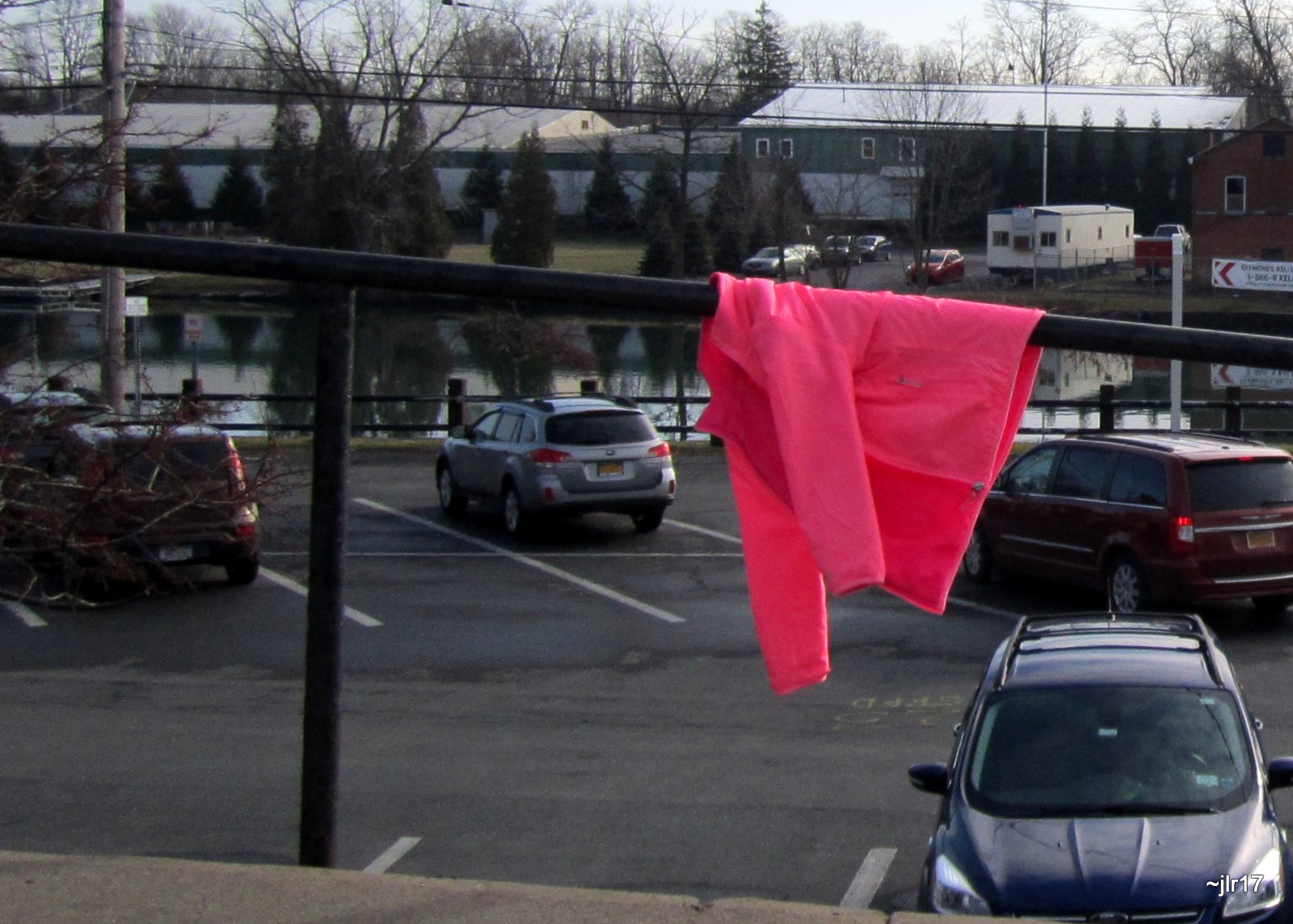
There was a purple glove atop a signpost so its owner could find it. A little girl’s bright pink jacket was draped across a railing. Lost and found, on the street. Forgotten items lifted to a place where others could see.

So many feet had padded the ground which was still saturated from the recently melted snow. The grass was matted and muddy. But I imagined in a few more hours there would be little trace of the thousands of people who touched this place today.

It was inspiring being surrounded by so many monuments to brave women and their successes, and humbling to be reminded that we’ve only had the right to vote for four generations.

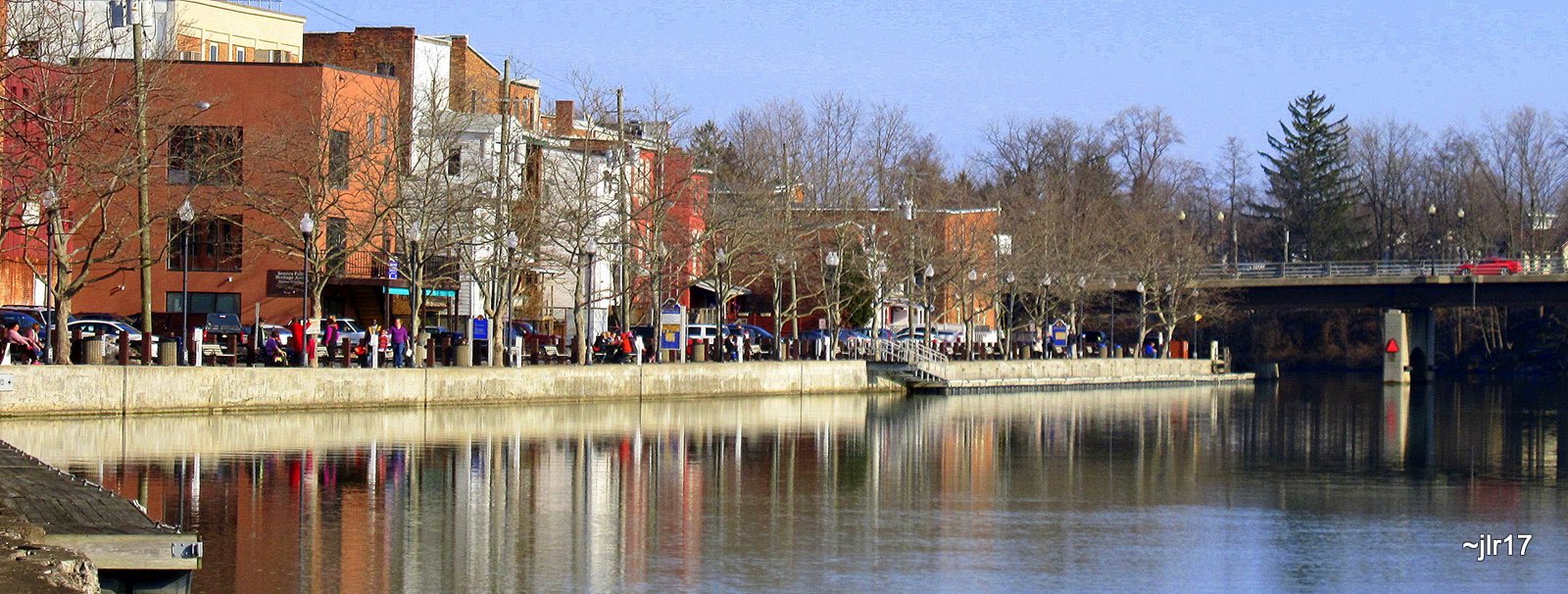
I chose Seneca Falls because I felt being here where women fought for their most basic right to equality meant something. I wanted to show my support in a place that mattered. Today would be added to its history.

Grandmothers to mothers to daughters, we’re still working on supporting each other. How do we use this impetus for equal rights for all human beings? And how do we unite our impetus as women when the diversity of causes seems to outnumber people?

On the drive home I heard an interview with a woman named Darcy from Tacoma Park, Maryland. She marched in Washington D.C., today along with her nine-year-old daughter and half-a-million others.

She said she supported the new president and the message she took for the day was that women need to seek elected office for their voices to be heard.

“I’m not here out of anger or fear,” she said. “I’m out here out of determination, participation, and hope.”

Me too, sister. Me too.

Suffragists fought for women and in 1920 we won the right to vote; in 2020 we need women for whom we can cast our votes. That’s one new fight.

And bring a coat.


Update: Monday, Jan. 23, 1:42 a.m. FingerLakes1 posted a video of the afternoon speakers on its Facebook page. https://www.facebook.com/fingerlakes1/videos/10154111982561389/

Wednesday, November 23, 2016

American Pie


Riding shotgun on the faceless stretches of an interstate highway during her trek from home to family for the Thanksgiving holiday, my hungry cousin took to Facebook on her smartphone for boredom relief.

“What’s your favorite holiday pie???” she posted. “(I need entertainment and I’m hungry!!!)”

Over the course of the next five hours, a motley crew of family and friends waxed poetic about the pie of their deepest desire.

Pumpkin, pecan, (and its mature cousin bourbon pecan,) strawberry rhubarb, apple (with chocolate ice cream), mince, blueberry, chocolate cream, key lime, and lemon meringue rounded out the list for which most drooled.

Whether whipped cream is justified, or not was discussed.

“Does cheesecake count?” one friend asked with a winky-smiley-face emoji.

“Does a bear crap in the woods?!!” came the reply.

“Pizza pie. That counts, right?” asked another.

“It has ‘pie’ in the name and therefore counts,” my cousin replied. “I can totally get behind this.”

Yet another posted, “Cake???”

You know the answer, without a doubt, absolutely.

Everyone is invited to the party.

Introductions were made, recipes and stories were shared, and I was reminded of the Library of America’s short story pick for this week:
http://storyoftheweek.loa.org/2016/11/the-tyranny-of-pie.html


George Augustus Sala
In 1882, British journalist George Augustus Sala toured America to cover the American scene. Thankfully, his journey was a bit more rural than the boredom-provoking superhighways we use now.

In ‘The Tyranny of Pie', one article he wrote of his trek, Sala provided a brief insight into his pie-consuming experiences while he traveled through our country.

“It is a Fetish. It is Bohwani. It is the Mexican carnage god Huitchlipotchli, continually demanding fresh victims. It is Moloch,” Sala wrote of the nation's obsession with pie.

"(O)ne topic of conversation is no longer the Almighty Dollar - but to the tyranny of Pie there is no surcease," he observed.

"Men may come and men may go; the Grant “Boom” may be succeeded by the Garfield “Boom;” but Pie goes on for ever.”

As an applicable metaphor for the spirit and complexion of Americans he said, “the worst of this dreadful pie – be it of apple, of pumpkin, of mulberry, or of cranberry – is that it is so very nice.”

A possible allusion to the unassuming way Americans make the best things about life accessible he wrote, “(Pie) is made delusively flat and thin so that you can cut it into conveniently-sized triangular wedges, which slip down easily.” In contrast to “roast beef of Old England” which is expensive and much harder to come by.

We’ve added cheesecake, cake, and pizza to our pie repertoire. I love my cousin for underlining this.

photo by chef david burke fabric
And here's some more food for thought: As of last year, the turducken (a chicken stuffed inside a duck stuffed inside a turkey) is out, replaced by the piecaken. Yes. Piecaken.
http://www.nytimes.com/2015/11/26/dining/forget-turducken-its-piecaken-time.html

The worst of this dreadful pie is that it is all so very nice.

Seconds to that, sir. Seconds to that.

Happy Thanksgiving everyone.


Friday, November 18, 2016

The Cavalry Will Not Save Us

Whom you vote for is none of anyone else’s business.

That’s not what this is about.

In its simplest terms, this is what I learned in the last ten days: nearly half (42%) of the country’s voting-eligible population did not vote. We need full participation if we are to ever have a clear mandate for the direction of the country.
(See spreadsheet: United States Election Project website, http://www.electproject.org/2016g )

Evidenced by the conversations surfaced this week in Washington D.C., and all media across the country, half of those who did vote felt they’ve been holding their tongue for the past two elections, and Wednesday morning when they woke up they could breathe for the first time in eight years.

The other half of voters now feel they will lose hard fought rights. For them, the morning after election day and every day since, they’ve taken to the streets in protest.

That’s what this is about. We need to keep doing these things – speaking our minds, out loud.

A few days before the election, Van Jones, political commentator for CNN, for his ‘The Messy Truth’ episodes, visited white voters in Gettysburg, Penn. He asked how they thought we got to the point where disagreement is the equivalent of hostile warfare.

“I’m just worried now, just concerned,” Jones said.  “So are we,” the Gettysburg dad said.

Jones and the Gettysburg folks are all right: we must learn how to talk and listen to each other.

Debate in this country used to be different. At home around the dinner table, on television, radio, and in print news, we had valuable arguments – not quarrels – with information from people we knew, and cared about, even trusted to help us make informed opinions. We need those real conversations, even (and especially) when they get heated, with people who matter. It’s crucial to understanding each other. There are not enough places where this still happens. We need to fix that. Now.

A long-running debate show, Intelligence Squared, circulated a petition before and during the debates pleading with the Commission on Presidential Debates for the chance to host meaningful discourse. Its plea fell on deaf ears.
(See video:  intelligence2 debates, How to Fix the Presidential Debates, with moderator John Donvan,  http://www.intelligencesquaredus.org/news/blog/how-fix-america%E2%80%99s-presidential-debates )

Instead, we devolved into a Saturday Night Live Point/Counterpoint parody skit from the 1970s hurling ‘Jane, you ignorant slut’ comments at each other.
(See video: NBC Saturday Night Live, Weekend Update: Point/Counterpoint with Dan Akroyd and Jane Curtain http://www.nbc.com/saturday-night-live/video/point-counterpoint-lee-marvin-and-michelle-triola/2846665 )

The cavalry is not coming. We need to fix this together and we need each other to do it. All of each other, not just the half who decided to show up on election day.

Voting is how we express our will. Protesting is how we express our will. Communicating with each other in a productive way is how we express our will.

It’s not the job of politicians to tell us what is important. With our votes, we hire them to spend our money, to exercise our will, and to protect our nation. If we’re unclear about how we want them to wield that power we will not get the results we want; not in the laws or policies we need, and ultimately the power with which we entrust them can be, and often is abused.

And for many voters that abuse occurs at the hands of people they did not select to represent them.

And it’s more than ‘if you didn’t vote you don’t have a right to complain.’ We need everyone’s voice in these decisions. Abstention is not an option.

This cycle, as in so many recent elections, the president-elect does not have a mandate. He lost the popular vote. He is unique in that he is arguably neither a Republican or a Democrat, as he has held all sides on every major position. His leadership path is not clear. With neither a mandate nor clear path of motive and intent, we risk being abused.

Our government works because it is a system under tension. That’s how it was designed. When we respect that tension and each other, government works best. It’s never been easy. But that’s OK. It is our strength, not our weakness.

Conservatives worry about liberty: liberals worry about justice. Minorities worry about the empowerment of hate groups; majorities worry about their loss of identity. Some see these as swinging pendulums. They are more like bulldozers pushing against each other. 

It does not serve the greater good to lie or deceive each other about how much fuel is in the tank and when we last serviced the engines.

We are the cavalry. As a multicultural, pluralistic, democratic republic we are unique and no one is guiding the way for us. It’s up to us to save ourselves and each other.

I’ve tried very hard in the last week to find my power in this moment. My strengths include research and writing. It’s a small thing, but I feel like we – or at least I – need some baby steps toward sincere and honest communication right now.

The reasons each of us made the choice we did were complicated and complex. My bias, for the record and from my heart, is here: I see too much Federal government intervention; I am monumentally fiscally conservative; I am extremely socially liberal; I am concerned about protecting the environment; and I am against continued use of the United States Military as the police force for the world, funded by Americans. And, I am a woman.

I understand that my personal convictions filter my view of the world.

And now, in this moment, the first woman for president was nominated by a major party, the only other major party nominee declared he would shake up the government with allegiance to no establishment but his own, and the only viable third party candidate (on the ballot in all 50 states) was sorely underfunded, undersupported, and some say unprepared for a real shot at winning.

It was a difficult choice.

Now, watching everyone beat themselves and each other up is painful and depressing.

As I work through identifying what and how I will participate civically for the next few years I’ve added a page to my blog for links to websites whose contributors are working to help clean up our resources. Some are my go-to sites which have held up since journalism classes. Others are new sites whose admins are working right now to help make our discourse more transparent.

Also, I am supporting the American Civil Liberties Union.

And I support Federal Reserve Chair Janet Yellen's fiscal pushback.

But there’s so much more work to do.

Peace for now,
Reb

P.S. And if you didn’t (or don’t) vote, it’s time to step up. It’s your civic responsibility.

We needed you this time and you let us down.

Sunday, February 7, 2016

Murmuration

“Look up!”
A distant darkness,
its pixelated air current shadow
undulates.
Infinitely dimensional
bird cloud dance
overhead.
Millions of voices and bodies,
twice as many wings
shape-shift.
Stochastic fast-slow system:
small changes, small surprises,
critical transition.
I whisper, 
“It’s not raining.”


Video Produced by Paul Dinning - Wildlife in Cornwall
(used with permission.)

Monday, March 24, 2014

98 Days

April 8, 2014 is Equal Pay Day.

That's how far into the year a woman will work for free compared on average to the wage of her male colleague - 98 days.

Earlier this month the AAUW released its annual statistics on the gender pay gap. Guess what?

It's still there.

Even though Congress passed The Equal Pay Act of 1963 -- 51 years ago -- women continue on average to earn less money working the same jobs as men.

In the 1960's the rate of inequality was recorded closer to 64%, but now it hasn't budged in a decade: The March 10, 2014 report shows that in 2012 women on average still only earn 77% of what their male equivalents earn, the same as it was in 2002, 2003, 2004, 2005, 2006, 2007, 2008, 2009, 2010 and 2011.

1930_women.jpgBut I don't see this as a gender problem.

I see it as a societal one that with better tools we can resolve together.

In real numbers: if a man earns $35,000 a year and the woman next to him doing the same job only earns 77% of that, it means $27,000 a year for the woman - which factors out to be $600 less per month or $150 less per week. Or if she went to work every week from January 1 to April 8 without receiving any pay at all.

Or worked every Monday all year long for free. And some Tuesdays.

Men - if you knew that the competent woman next to you was being paid 23% less to do the same job, would you want to fix that?

My hope is your answer is, 'yes' because if it's 'no' then we have a much bigger problem.

A key here to the correction is wage transparency. We can't talk about what we don't know. We won't fix what we can't see.

Working women and men should never be under the threat of reprisal for sharing their salaries with each other.

Enter Lilly Ledbetter. From the National Women's Law Center:
"Lilly Ledbetter was one of the few female supervisors at the Goodyear plant in Gadsden, Alabama, and worked there for close to two decades. She faced sexual harassment at the plant and was told by her boss that he didn’t think a woman should be working there. Her co-workers bragged about their overtime pay, but Goodyear did not allow its employees to discuss their pay, and Ms. Ledbetter did not know she was the subject of discrimination until she received an anonymous note revealing the (significantly higher) salaries of three of the male managers.
After she filed a complaint with the EEOC, her case went to trial, and the jury awarded her back-pay and approximately $3.3 million in compensatory and punitive damages for the extreme nature of the pay discrimination to which she had been subjected."
Within months of the Lilly Ledbetter decision, in 2009 Congress passed the Fair Pay Act that gives employees some ability to challenge discriminatory compensation practices.

But having worked recently for a company with sketchy wage awards, I can tell you The Fair Pay Act does not go far enough.

After one woman in the company accidentally learned she fell into the wage gap, she attempted to renegotiate her salary with her boss. For more than six months she tried to convince him to pay her more, only to hit brick wall after brick wall.

Due to a clause in the employee handbook preventing open discussion about pay, she could not divulge to her boss that she knew she was being paid significantly less than her male counterpart. 

Further, she and her male colleague never had an honest conversation about why or how it happened. Only the boss knew why, yet he refused to acknowledge the situation. After all, she wasn't supposed to know there was a gap - and risked losing her job if she said she let on that she knew.

She contemplated filing an equal pay discrimination action with the EEOC. She learned from former employees of other suspicious hiring and preferential pay practices. The problem was, all of it could be explained as something other than gender bias or discrimination.

Was her substandard pay rate gender related?

Would her male colleague have stepped up to help rectify the situation if he had known?

As the advantaged benefactor would he even have perceived it as unfair?

What if the question of pay could have been an open one within the office?

Would that have changed anything?

What would you have done?

In this case we'll never know. Fearing retribution in an industry where she still worked, and without an emotional or financial safety net, she dropped her pursuit for the truth, got another job and moved on with her life.

It will only be after we can start talking openly with each other without fear of losing our jobs that we stand a better chance of shedding enough light on this 5,000-year-old problem to even begin trying to fix it.
While the solutions are not yet clear, doing something quiet is better than doing nothing.

As metaphor for the red ink women are drowning in, wear red April 8.

Sign this New York State Senator's Equal Pay for Women petition: http://www.nysenate.gov/webform/join-equal-pay-women-campaign-11

Talk about your pay. 

Even if you have to whisper.